Showing posts with label extreme environments. Show all posts

Tuesday, February 21, 2012

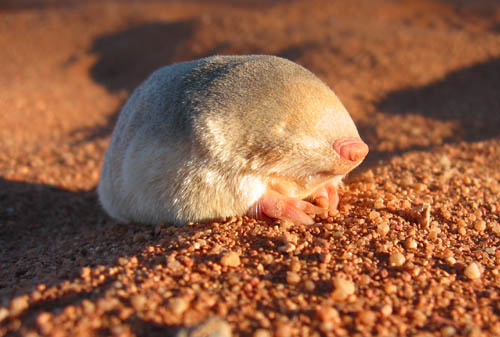
Is iridescent fur wasted on the blind golden mole?


Despite human demand for fur coats, mammals are still the dowdiest members of the animal kingdom. While many birds, insects, and mollusks have iridescent coloration that gives off a metallic, shimmering appearance, mammals rely on pigments to imbue their fur with a single, matte color. Biologists think that iridescent animals use their flashy coloration to lure mates. However, a recent discovery of iridescent mammalian fur throws a wrench into the sexual display hypothesis. The iridescent coloration is possessed by a mammal that cannot even see – the blind golden mole.

The golden mole (Family: Chrysochloridae) is a burrowing animal that lives underground in sub-Saharan Africa. It has no need for sight, and its eyes are covered by skin and fur. Despite living in darkness, its dense coat shimmers with green, blue, and violet highlights. Dr. Matthew Shawkey of the University of Akron examined the microscopic, physical qualities of golden mole hairs and found that they are specially constructed to produce an iridescent sheen.

Whether it’s the rainbow shine of a soap bubble or a hummingbird’s shimmering throat feathers, iridescence occurs when light hitting different surfaces is reflected at different angles – a process known as thin-film interference. For these surfaces to shine though, their thickness must be just right. When Dr. Shawkey looked at a golden mole hair under an electron microscope, he found that its outer layer was composed of alternating layers of electron-dense and electron-lucent material. These layers happen to be the perfect thickness to reflect light at angles that produce iridescence through thin-film interference.

Other characteristics of the golden mole hair enhance the iridescent coloration. Instead of a continuous, tubular shape like most mammalian hairs, golden mole hairs become flat towards the ends. This flattened shape, also seen in iridescent bird feathers, provides more surface area for light reflection. Also, the golden mole hairs are smoother than typical mammalian hairs. Most mammalian hairs are covered by rough, cuticular scales that diffuse light. However, the cuticular scales of the iridescent golden mole hairs are compressed and smooth, which focuses more light on the reflective layers.

Like all mammals, the golden mole’s coat is actually composed of two hair types. The iridescent hairs are the protective, outer guard hairs. Golden moles also possess non-iridescent down hairs, which are dense, curly, and provide insulation for the animal. Dr. Shawkey observed that, in contrast to the iridescent guard hairs, the down hairs of the golden mole are thin and tubular with large cuticular scales. While they did not have the layered substructure of the iridescent hairs, their cells had many pigment organelles called melanosomes. The iridescent guard hairs on the other hand contained very few melanosomes.

While iridescence in mammalian fur is an amazing discovery, the reason behind such a trait, especially in a blind animal, remains unclear. Dr. Shawkey hypothesizes that the structure of the iridescent hairs is actually conducive to the mole’s underground lifestyle. Flattened guard hairs may help the moles move through the dirt. Also, the small, compressed cuticular scales likely reduce friction. It just so happens that these adaptations also give the golden mole guard hairs the perfect structure for iridescent coloration. For a mammal that never sees the light of day and couldn’t if it tried, the golden mole’s iridescent fur gives new meaning to ‘beauty is in the eye of the beholder.’

Holly K. Snyder, Rafael Maia, Liliana D'Alba, Allison J. Shultz, Karen M. C. Rowe, Kevin C. Rowe, and Matthew D. Shawkey. Iridescent colour production in hairs of blind golden moles (Chrysochloridae. Biol Lett 2012 : rsbl.2011.1168v1-rsbl20111168. 

Photo: Namib Desert Golden Mole, Eremitalpa granti namibensis. By G. Rathbun, Afrotheria.net

Wednesday, January 25, 2012

The ocean's most exclusive community.


The great thing about science is that questions lead to answers. The bad thing is that through this process, a subject that was once novel and strange slowly loses its mystique. When the thrill is gone and the mysterious becomes mundane, the jaded biologist longing for that delicious scientific buzz need only look down - way way down. And, oh my GOODNESS, a really thrilling bit of science was just pulled up from the uncharted ocean depths and published in PLoS Biology.

Deep-sea hydrothermal vents! Is there anything more amazing? They are remote like outerspace but with thriving communities of freaky biota. And as a team of researchers, led by Dr. Alex Rogers of Oxford University, recently found – if you’ve seen one you have NOT seen them all.

These ecosystems are so mystifying because they are fundamentally different from the ecosystems we are used to seeing. Whether you are in tropical rainforest, arctic tundra, or open ocean, nearly all food webs are built upon the plants and algae that harness sunlight to transform carbon dioxide into organic molecules. Photosynthesis is incredible, but also pedestrian. Things get really strange when you look into the darkness and find bizarre organisms that have capitalized on a different energy source – poisonous, smelly hydrogen sulfide gas.

Deep-sea hydrothermal vents, found at an average depth of 2100 meters, spew plumes of hot water from the earth’s crust. This water can be as hot as 400˚C and contains high concentrations of hydrogen sulfide. The surrounding water is nearly freezing and dark as night with pressures so great it keeps the hot plumes from boiling. Still some organisms have managed to thrive in this oppressive environment. Not surprisingly, it all comes down to the microbes. Bacteria and archaea living in and around the vent utilize the energy stored in the bonds of hydrogen sulfide to fix carbon dioxide into organic molecules. This process, known as chemosynthesis, was only a theory until it was observed in action at the hydrothermal vents of the Galapagos Ridge in 1977.

The unusual properties at the base of the vent food web radiate up through all the animals it supports. The giant tube worm that hosts chemosynthetic bacteria within its body is the most familiar image. In many ways it has assumed the role of the community’s iconic species. That is until Dr. Rogers and his team restored the mystique of the hydrothermal vent ecosystem.

Departing from the vents of the tropics and subtropics that are relatively easy to access, the team examined the communities on the East Scotia Ridge (ESR), 500 km to the east of Cape Horn between South America and Antarctica. At a depth of more than 3000 meters in the Southern Ocean, the ESR has two ridge segments with hydrothermal activity, E2 and E9. A deep-sea drive by the remotely operated vehicle Isis revealed that these areas are completely devoid of the tubeworms, polychaetes, clams, and shrimp that we’ve come to expect in hydrothermal vent communities. Rather, they host a complex community of endemic organisms – organisms that haven’t been seen anywhere else – notably a new species of crab, stalked barnacles, limpets, snails, sea anemones, and a seven-armed starfish.

The biological diversity of these areas is built upon the diverse landscape. In some spots chimneys as tall as 15 meters release concentrated plumes of mineral-rich water from the Earth’s crust. This water emerges at temperatures exceeding 300˚ C, and when it hits the near-freezing water of the ocean floor, the minerals fall out of solution and create that black smoker appearance. In other areas there is more diffuse vent flow with temperatures closer to the surroundings. Even between the two sites there is variation in the chemical composition of the vented liquid. These differences could affect the microorganism populations at the two sites which would have cascading affects up the food web.

The truly thrilling thing about the ESR discovery is not the strange biota, because, let’s be honest – finding new species in a remote habitat is old hat. The amazing thing is WHY the species are so strange and why the ESR community is different from the ones we see in similar ecosystems. While they seem inhospitable to us, hydrothermal vents are the only suitable habitat for these organisms. In that way they are just like islands out at sea or parks in an urban landscape. Biogeography is the study of species distributions across space – the traits of an organism that lead it to new areas and the barriers that stand in its way. And remarkably, when you consider all the geologic, hydrologic, and biologic pieces of the puzzle, it appears that hydrothermal vent communities suggest the same patterns of biogeography that govern terrestrial communities.

Deep ocean organisms face unimaginable hurdles to dispersal. Larvae might catch a ride on an ocean current, but many of them won’t last long before passing by another hydrothermal vent. These vents are found only at the boundaries of tectonic plates, which would serve as a great dispersal corridor if they corresponded with the currents. They don’t. Even more daunting is the surface to sea-bed Polar Front, which encloses the Southern Ocean and effectively blocks the entry of outside organisms. At the Polar Front water temperatures and salinity levels change abruptly, creating an insurmountable physiological challenge to most organisms attempting to cross. Knowing this it’s really no shock that the ESR has so many endemic species and so few of the usual suspects. With these barriers preventing migration, the populations of the ESR have been held in reproductive isolation for millions of years with the forces of evolution at work.

However, over geologic time scales ocean currents and plate movements are not even constant, which adds a whole new twist to the story! The hydrothermal vents appeared when the ESR began to spread – around 15 million years ago. That period corresponded with climatic conditions that made the Polar Front less intense, meaning that organisms dispersing from other vent communities actually had a chance to colonize this brand new environment. But the gates closed around 13.8 million years ago when the climate changed and the Polar Front strengthened.

Even more interesting is the phylogenetic history of one of the ESR endemics, which seems to corroborate the geologic and climatic stories. A new species of Kiwa crab, found in the vents of the ESR, is closely related to K. hirsuta of the nearby Pacific Antarctic Ridge. By looking at differences in their genetic markers, researchers loosely estimated that the two species diverged around 12.2 million years ago. Other ESR animals show similarity to species found in hydrothermal vents in the lower latitudes of both the Atlantic and Pacific. The dispersal of organisms from two oceans was likely aided by the Antarctic Circumpolar Current, which circulates around Antarctica, linking the Atlantic, Pacific, and Indian Oceans.

Dr. Rogers' team’s research adds another layer of complexity to the biogeography of vent ecosystems, even suggesting that the Antarctic vents comprise a new biogeographic province. For scientists and non-scientists alike it represents a whole new world of mysteries to be revealed, recharging our hope for big, exciting discoveries.

Rogers AD, Tyler PA, Connelly DP, Copley JT, James R, et al. (2012) The Discovery of New Deep-Sea Hydrothermal Vent Communities in the Southern Ocean and Implications for Biogeography. PLoS Biol 10(1): e1001234. doi:10.1371/journal.pbio.1001234

Tuesday, January 26, 2010

The Toughest Snail on the Planet

Black smokers, a type of hydrothermal vent, create some of the harshest environmental conditions on the planet. These undersea chimneys propel superheated, sulfide-rich water from below the Earth’s crust into the deep ocean. Upon contact with the cold water of the ocean, dissolved iron sulfides precipitate out of solution and deposit onto the surrounding ocean floor. From the extreme heat (roughly 350 deg C), acidity, and suffocating chemical concentration of the water emerging from black smokers to the crushing pressure and complete darkness of the deep ocean, it’s shocking that organisms can even exist in this unforgiving abyss, let alone thrive. Yet as nature has proven time and time again, organisms adapt to exploit the conditions that we terrestrial dwellers consider most inhospitable.

Just like John Rambo, the organisms that can survive an environment as ruthless as a black smoker must be incredibly tough – even tougher than modern soldiers. For this reason MIT’s Haimin Yao has been studying the body defenses of the Scaly-foot Gastropod (Crysomalion squaminferum). The Scaly-foot Gastropod is a resourceful little snail that was discovered nine years ago at the base of black smokers near India, and it just may possess the most effective armor ever discovered.
Yao examined the shell at the nano-meter level to understand how it protects the soft body within from the extreme heat and acidity of black smoker water. It must also withstand the crushing power of predatory crabs. The shell of the Scaly-foot Gastropod is made of three layers, each composed of different materials to serve a different purpose. Together, they form a structure that's completely unlike any known armor, natural or man-made.

The outer layer is the thinnest and toughest, composed of iron sulfide particles extracted from the water surrounding the black smoker. This layer is designed to be sacrificed. When it is crushed by a crab claw (simulated in the lab by a diamond-tipped probe), the outer layer breaks but only into tiny cracks. By allowing these slight cracks, the outer layer dissipates the energy of the attack, and prevents the shell from shattering completely. The tough iron minerals of the shell can also wear down the crab's claw.

The middle layer is thick and soft. It is composed of organic matter rather than minerals. Its spongy consistency also absorbs the force of the crab’s claw, protecting the integrity of the inner layer. The outer and middle layers meet at a wavy junction rather than a flat one. This design keeps the two layers stuck together, preventing them from sliding apart.

Below the first two layers, the Scaly-foot Gastropod resembles the snails we’re familiar with. The inner layer of the shell is composed of calcium carbonate, the most common material for snail shells. If an ordinary snail were exposed to the acidic water of the black smoker, however, its calcium carbonate shell would rapidly dissolve. With the two outer layers, the Scaly-foot Gastropod can protect its inner shell, which provides structural support and prevents the shell from bending under the grip of a crab claw.

The three-layered armor makes this soft, vulnerable creature nearly invincible, even in the most extreme environment. Yao believes that this natural design could help to inspire the next generation of man-made defenses – from body armor to vehicles and sporting equipment. Perhaps we’ll see Scaly-foot Gastropod armor on Sylvester Stallone in the next installment of Rambo – Badass in a Mollusk Suit.

Learn more about the defenses of the Scaly-foot Gastropod in Yao’s article, published in the Proceedings of the National Academy of Sciences.

Photo: Our friend, the Scaly-foot Gastropod, courtesy of Anders Waren.